Eugene Fama and David Booth: The Fifty-Year Partnership That Changed How the World Invests
Why Beating the Market Is a Losing Game — And What to Do Instead
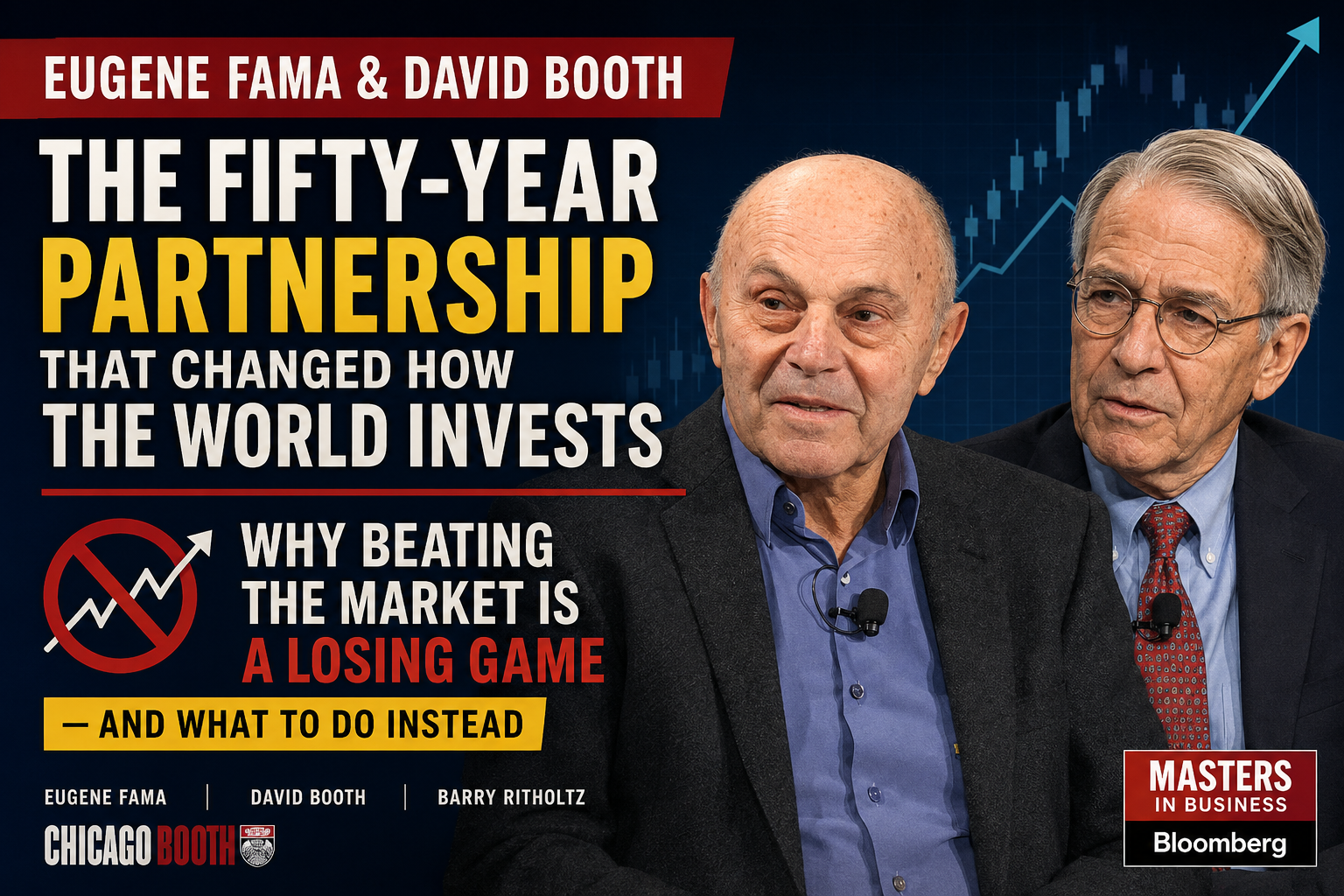
Based on a conversation between Eugene Fama, David Booth, and Barry Ritholtz at the University of Chicago Booth School of Business, recorded for "Masters in Business" (Bloomberg).
The Core Thesis
Markets are efficient, and that has a specific, testable arithmetic consequence: consistently beating the market is essentially impossible, so investors are better served by capturing market returns cheaply than by paying for active management.
Everything else in this article supports that one idea:
- Fama's academic case — his early "data dredging" lesson and his 1965 doctoral thesis established that past price patterns (chart reading) don't predict future prices, laying the foundation for the Efficient Market Hypothesis.
- Booth's real-world proof — Dimensional Fund Advisors took that theory and applied it, building a large, successful investment firm not by trying to beat the market, but by capturing it efficiently — including small-cap and value premiums — at low cost.
- The zero-sum arithmetic — since passive investors hold the market as-is, every active bet that overweights something must be offset by someone else's underweight. Active management collectively cannot beat the market before costs, and loses to it after costs. This is presented as mathematics, not opinion.
- The behavioral finance pushback, and Fama's rebuttal — Fama argues that critiques of efficient markets (from Thaler, Shiller, and others) have not produced an alternative theory that can be tested and falsified the way the Efficient Market Hypothesis can.
- The payoff, in human terms — Booth frames the entire fifty-year project as one that lowered fees and improved outcomes for ordinary savers and retirees — also the emotional core of why he made his largest-ever gift to the school.
In one sentence: a Chicago professor's discovery that markets are hard to beat, and his student's decision to build a business around that discovery instead of fighting it, together reshaped how the world invests.
Introduction
Eugene Fama is widely described as the father of modern finance. A Nobel laureate who has taught at the University of Chicago since the 1960s, Fama has trained thousands of students over five decades. One of them, David Booth, went on to co-found Dimensional Fund Advisors (DFA), which grew into a roughly $600 billion institutional asset manager. Their relationship — professor and star pupil, later business partner and board member — now spans fifty years.
The two sat down together at the Booth School of Business, which was renamed in 2008 following Booth's transformative donation to the university, for a wide-ranging conversation covering the birth of efficient market theory, the founding of Dimensional, the ongoing debate with behavioral economics, and what markets can and can't tell us about themselves.
Fama's Path Into Finance
- As a student at Tufts University, Fama worked for Professor Harry Ernst, who ran a side business forecasting the stock market.
- Fama built models designed to beat the market. They performed well on the historical data he had fitted them to, but failed on new, out-of-sample data.
- Fama has described this as an early lesson: "data dredging" can make patterns appear where none really exist — a warning about overfitting that shaped his later academic skepticism toward claims of market-beating strategies.
- Fama applied to the University of Chicago but never heard back. As his story goes, he called the school directly and reached the Dean of Students, who admitted there was no record of his application. After hearing about Fama's grades, the dean offered him a scholarship reserved for a Tufts student on the spot.
- After finishing his studies, Merton Miller encouraged Fama to remain at Chicago as faculty — an unusual move at the time, since schools rarely hired their own PhD graduates onto the faculty.
The Birth of Efficient Market Theory
- When Fama arrived at Chicago, serious academic research into asset prices was just getting underway.
- A key driver was the arrival of computers: before 1960, researchers didn't have serious computing power for data analysis. Once computers became available, economists and statisticians had a "new toy," and stock price data was readily accessible — making it one of the first areas of serious quantitative study.
- Economists began asking a foundational question: how should prices behave if the world — and markets — were working properly? Many competing theories were proposed before the field converged on what became known as the Efficient Market Hypothesis (EMH).
- Fama's 1964 doctoral thesis, "The Behavior of Stock Market Prices," was published in the Journal of Business in 1965. It concluded, in essence, that chart reading, while perhaps an interesting pastime, has no real forecasting value — a direct challenge to technical analysis and the idea that past price patterns predict future ones.
- The pushback came almost entirely from investment professionals, not academics. Within academia, the data and evidence were persuasive, and the ideas were adopted quickly.
- Fama and Booth both describe this period as a genuine turning point — a "sea change" in how people think about investing, sometimes referred to as a dividing line between "pre-Fama" and "post-Fama" finance.
David Booth's Path to Chicago
- Booth grew up in Kansas and earned a BA in economics and a master's degree from the University of Kansas.
- A finance professor at Kansas — himself a Chicago PhD — told Booth that finance was "exploding" as an academic discipline and that Chicago was one of its epicenters. That conversation led Booth to apply.
- Booth took Fama's class as his very first class at Chicago, roughly fifty years before this interview (making it the fall of that year — notably also the first year Chicago fielded a football team in 34 years).
- Booth describes the experience as life-changing and transformative — not only did it lead directly to his career, but it also gave him a strong sense of public purpose: a belief that the work being done at Chicago could genuinely make investors' lives better.
- Booth became Fama's teaching assistant — Fama's practice was to select the top student from the previous year's class for the role.
- Rather than pursuing academia, Booth realized he could never out-compete Fama as a researcher and instead saw an opportunity to be the one who applied the groundbreaking ideas coming out of Chicago to the real world, at a time when none of the research was yet being put into practice.
From Academic Theory to Wells Fargo
- After finishing his MBA, Fama connected Booth with Mac McGowan at Wells Fargo, where an institutional team was developing what became one of the first index funds.
- McGowan had been a regular attendee at seminars Chicago's Center for Research in Security Prices ran twice a year for business practitioners, and he was known for being receptive to the new academic thinking.
- Booth describes his time at Wells Fargo as formative — he learned that the investment business is part investment science and part client work. As he put it, he studied finance for two years but has been studying client work for decades since.
Founding Dimensional Fund Advisors
- Booth started Dimensional Fund Advisors (DFA) out of the second bedroom of his apartment in Brooklyn Heights, running its first fund himself as portfolio manager.
- The firm's original pitch was straightforward: standard indexing at the time typically excluded or underweighted small-company stocks. Dimensional's argument was simple — investors should hold the market, including small caps, not just large caps. This became the sales pitch that "put them on the map."
The Small/Micro-Cap Fund and Market Microstructure
- Dimensional's first fund was similar to an index fund but differed in one key respect: it did not trade at the market close the way many index funds did. Instead, it traded stocks throughout the day.
- This drew skepticism, particularly from academics, under what was then called "market microstructure" concerns: trading small, illiquid stocks against institutions with more information seemed like a recipe for being picked off ("why won't they just rip your eyes out when you're trading?").
- Booth and his colleagues found practical ways to use the structure of markets to their advantage — for example, recognizing that when an institution urgently wants to sell, its anxiety to complete the trade quickly can be used to negotiate a better price. Being a patient, flexible trader allowed Dimensional to avoid the large bid-ask spreads that conventional wisdom assumed were unavoidable.
- Two academic theses conducted at Chicago on small-stock returns had concluded that while the historical returns looked good on paper, an investor would be "swamped by trading costs" trying to capture them in practice. Dimensional's approach — using patient, flexible execution — is what allowed the firm to actually deliver the small-cap premium rather than lose it to trading costs.
- Dimensional's earliest clients (starting around 1981) were large pension funds and insurance companies that were underweight small-company stocks relative to the broader market — a straightforward diversification argument that resonated with institutional investors.
The New York Telephone Story
- As the firm grew out of Booth's apartment, he called New York Telephone to request six or eight additional phone lines. The company initially refused, apparently suspecting he was running a bookie operation out of the apartment.
- Booth had to call the treasurer of New York directly to get the lines installed. It turned out only six lines were available on the entire block. The punchline, as Booth tells it: the City of New York later became a Dimensional client.
Fama's Role at Dimensional
- Fama has been connected to Dimensional since before its founding — Booth's very first call when starting the firm was to Fama, asking him to be a founding advisor providing ongoing access to current academic research and thinking. Fama agreed immediately.
- When Dimensional needed to launch a mutual fund requiring an independent board of directors, Booth and his co-founder Rex Sinquefield approached Chicago faculty directly. Merton Miller agreed on the spot to join, and as he left his office, he ran into Myron Scholes, who also agreed. Until recently, all of the fund's independent directors had taught at Chicago.
- Rex Sinquefield, Booth's Dimensional co-founder, had also been a student in Fama's class and was known even then as an unusually engaged, curious student.
The 2008 Gift and the Naming of Chicago Booth
- In 2008 — in the middle of the global financial crisis — David Booth made the largest donation in the history of the University of Chicago Booth School of Business, a gift that led the school to be renamed in his honor.
- The gift consisted primarily of stock in Dimensional Fund Advisors rather than cash, since the firm had only recently begun accumulating significant cash reserves. The university took on the risk of holding that equity stake, which turned out to be a strong bet, and it continues to generate returns for the school.
- Booth has framed the decision in terms of gratitude and market logic: markets work because both sides of a voluntary transaction believe they're getting a fair deal, and Booth felt it was "time to pay back" the institution that had shaped his entire career.
- Booth did not initially set out to make it a naming gift — that idea came from then-Dean Ted Snyder, who suggested naming the school after Booth as an alternative to a separate naming-gift campaign the school had been planning.
- Fama notes the gift had a broad institutional impact: an infusion of resources that supported the creation of multiple new research centers and gave the school a sense of long-term security.
The Nobel Prize (2013)
- Five years after Booth's gift, Fama received a call from Sweden very early in the morning (around 1 a.m. Stockholm time) announcing he had won the Nobel Memorial Prize in Economic Sciences.
- Reporters showed up at his door within about ten minutes of the announcement. Despite the honor, Fama refused to cancel his class that morning — he says he had never missed a class in fifty years of teaching and wasn't going to start then, out of respect for the students paying for the course.
- Booth accompanied Fama to the Nobel ceremony in Stockholm. Having already attended the ceremony twice before (for Myron Scholes and Robert Merton), Booth arranged something special: a private evening at the ABBA Museum in Stockholm, complete with a "sing along with the band" stage exhibit, which was a hit with Fama's large extended family of children and grandchildren.
- A recurring anecdote from the visit: walking through the University of Chicago's central atrium after the announcement, students didn't look up or react — reinforcing, as Fama jokes, that "this is the University of Chicago; if they had to look up every time a Nobel Prize walked by..." A separate elevator encounter had a student in headphones completely ignoring both Nobel laureates riding alongside him.
Why Markets Are Efficient — And Why That's Good for Investors
- Fama argues that the accumulation of performance evidence over decades is what shifted broad opinion toward accepting efficient markets. Early landmark work — including Michael Jensen's thesis studying 25 years of mutual fund performance — showed that active managers, in aggregate, were not beating the market.
- Fama and Booth both stress a purely arithmetic argument: active management is a zero-sum game before costs. Since passive investors hold the market-cap-weighted portfolio without deviation, any active investor who overweights or underweights a stock must be offset by another active investor doing the opposite. If one wins, the other loses — as a matter of arithmetic, not opinion. After costs, active management as a group must underperform.
- On technology: despite dramatically faster information dissemination today than fifty years ago, Fama says there's no clear evidence in the data that markets have become "more efficient" as a result — prices have always looked highly efficient, and their volatility hasn't changed in ways that show a measurable technological effect.
- Real-world trends Fama and Booth point to as evidence of the shift: hedge fund performance was stronger before the 2008 financial crisis and weaker after; and a persistent flow of investor money away from expensive active strategies toward low-cost passive ones — investors "voting with their dollars."
- Fama's broader claim: it has "always been" a zero-sum game, and people have predicted "this will be the year of the stock picker" for as long as he's been in the business (almost fifty years), without it materializing as a durable trend.
Growth vs. Value and the Proliferation of Factors
- The conversation turns to a difficult stretch for value investing relative to growth, especially in U.S. large-cap growth stocks over roughly the prior decade, with weak relative performance in emerging markets, small-cap, and value strategies.
- Fama's response: there is enormous volatility in factor premiums like the value premium, making it statistically very difficult to determine whether the premium itself has genuinely disappeared or whether the recent underperformance is simply within the normal range of chance over that time horizon.
- He notes he and colleague Ken French were working on a paper examining this question directly at the time of the interview.
- Fama draws a historical parallel to the late 1990s, when value investing — and even Warren Buffett specifically — was widely dismissed as "washed up," typically right before a period of value outperformance began.
- Fama does not believe there are predictable cycles to factor performance; premiums move through good and bad stretches essentially randomly, and predictive tests the researchers have run show little to nothing of statistical value in forecasting them in advance.
- On the explosion of newly identified "factors" in academic finance (beyond Fama-French's original three-factor and later five-factor models, with hundreds of factors now claimed in the literature): Booth argues the proliferation has been overstated. In his view, there are probably only a handful of genuinely distinct underlying factors, with many "different" factors simply being alternative measurements of the same underlying phenomenon.
- Example: value can be measured through book-to-market ratio, cash flow to price, or many other variables — different lenses on essentially the same signal.
- Fama and French's own research approach emphasizes robustness testing — re-examining findings against new and different data sets. When they identified factors in their influential 1992 paper, they went back and tested the relationship using data extending back to 1926, and later tested it against international data, finding consistent patterns.
- Both note that with thousands of finance academics under pressure to publish for tenure, much of the reported factor research amounts to data mining that fails to hold up out-of-sample — underscoring the importance of robustness testing before treating a "discovered" factor as real.
The Behavioral Finance Debate
- Asked about behavioral economics — with Chicago sometimes cited as one of its birthplaces via colleagues like Richard Thaler — Fama offers a provocative, only half-joking claim: "There is no behavioral finance." In his view, the field is largely just criticism of efficient markets without a competing, independently testable theory of its own.
- Fama and Thaler are described as golf partners who, in Fama's telling, largely agree on the facts but disagree sharply on interpretation.
- Specific point of disagreement: Thaler's view is that the value premium results from investor misperceptions — investors misreading accounting and other information. Fama's counter is that if the premium is simply a correctable cognitive bias, professional managers should eventually be able to learn past it and arbitrage it away — yet emotional biases persist even among professionals who understand them intellectually.
- Fama recounts personally challenging Thaler roughly twenty years earlier to develop a testable theory that could be empirically evaluated against the efficient markets framework — a challenge Fama says remains unanswered ("we're still waiting").
- Fama notes, somewhat wryly, that Thaler — after winning his own Nobel Prize — said his plan was to spend the prize money as irrationally as possible, which Fama takes as a kind of concession.
What Is a "Bubble"? Fama's Skepticism
- Fama challenges the concept of market "bubbles" as commonly used by economists like Thaler and Robert Shiller, who describe a bubble as a period of excessive market enthusiasm pushing prices far above fundamental value.
- Fama's objection is methodological: for "bubble" to be a scientifically meaningful concept, it needs a testable, predictable ending — some way to identify, in advance, when a bubble will end. Without that predictive power, he argues, "bubble" is only ever identifiable after the fact, which makes it unfalsifiable as a theory.
- He recounts a well-known story (originating with researcher Holbrook Working) in which faculty at Stanford were shown charts they were told were historical commodity (wheat) price data and asked to identify bubbles. Every participant identified apparent bubble patterns — but the "data" was actually randomly generated, cumulative random numbers with no real market meaning at all. The takeaway: people are prone to seeing bubble-like patterns even in pure randomness.
The Value of Business Education
- Asked about societal skepticism toward finance and business education, Booth pushes back firmly: he argues the field has been a genuine force for improving people's lives — through lower fees, better risk controls, and more transparent, accessible investing.
- He recalls, with some frustration, criticism suggesting the only real advance in finance over the past fifty years has been the ATM (a remark attributed to economist Paul Volcker) — arguing instead that research from Chicago and elsewhere has materially lowered costs and improved outcomes for ordinary investors and retirees.
- Both Fama and Booth describe their continued motivation for working, despite having no financial need to do so, in similar terms: satisfaction from seeing retirees live better, from helping families afford things like their children's education, and from the intellectual reward of contributing genuinely new ideas to the field.
What's Next for Chicago Booth
- Fama reflects on the scale of change at the school since he joined the faculty in 1963 (a student there from 1960). At that time, the economics department was strong and a finance group was just developing — but by his account, most business schools nationally were academically weak (business education wasn't taken seriously as an academic discipline).
- Over the following decades, not just finance but every discipline at the school — marketing, accounting, statistics — became academically rigorous, producing what Fama calls "front-rank faculty in every single discipline," making the school unrecognizable compared to fifty years earlier.
- Fama's one lingering concern for the future: he believes today's students, in general, don't work as hard as students did in earlier decades — a critique he says he has voiced for a long time.
Key Takeaways
- Efficient Market Hypothesis (EMH): Prices reflect available information; consistently "beating the market" is extremely difficult, and chart-based technical analysis has no demonstrated predictive value.
- Active management is arithmetically zero-sum before costs, and negative after costs — a mathematical, not merely empirical, argument.
- Factor premiums (value, size, etc.) are real but highly volatile, making short- and medium-term underperformance statistically indistinguishable from a "premium that has disappeared."
- Dimensional Fund Advisors was built on applying Chicago's academic research to real portfolios — proving that a small-cap/value tilt could be captured in practice by trading patiently rather than mechanically at the close.
- Fama remains skeptical of both technical analysis and behavioral finance as predictive frameworks, arguing neither offers a testable alternative to efficient markets.
- "Bubbles," in Fama's view, are not a scientifically falsifiable concept unless they come with a predictable end point — and humans are prone to seeing bubble patterns even in random data.
- The Booth-Fama relationship — teacher and student, later business partner, benefactor, and Nobel Prize companion — is presented as a case study in translating rigorous academic research into a large-scale, real-world investment business.
Source: "Masters in Business" interview with Eugene Fama and David Booth, conducted by Barry Ritholtz at the University of Chicago Booth School of Business, Bloomberg Television. Watch the full conversation: youtube.com/watch?v=HRNczGwcTVQ